Email Us
News & Insights

How Does All-Metal Suspended Tracked Chassis Cut R&D Costs For University Labs & Robot Startups?

2026-07-30 0 Leave me a message

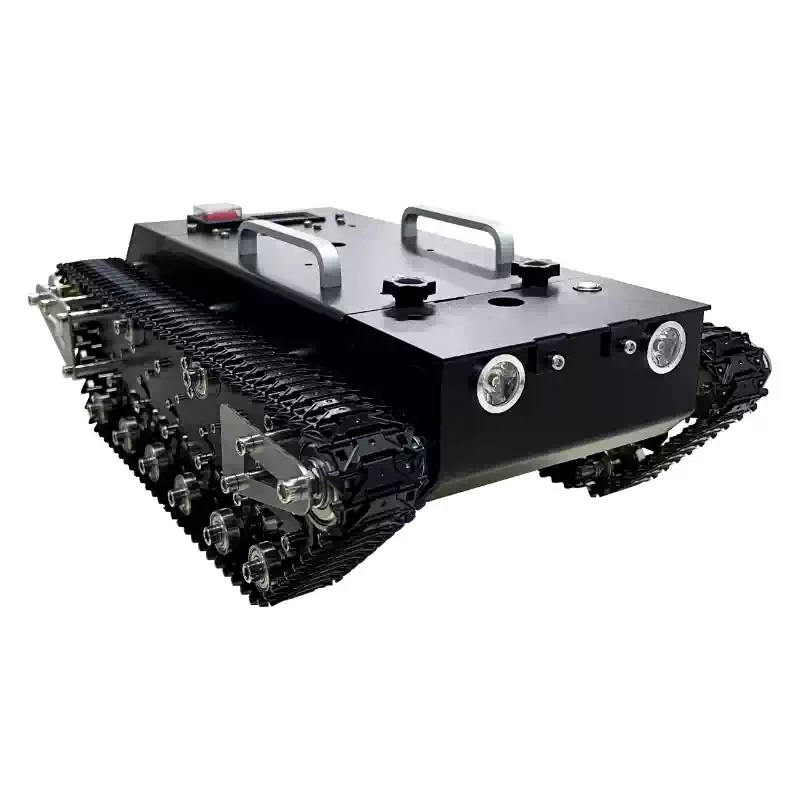
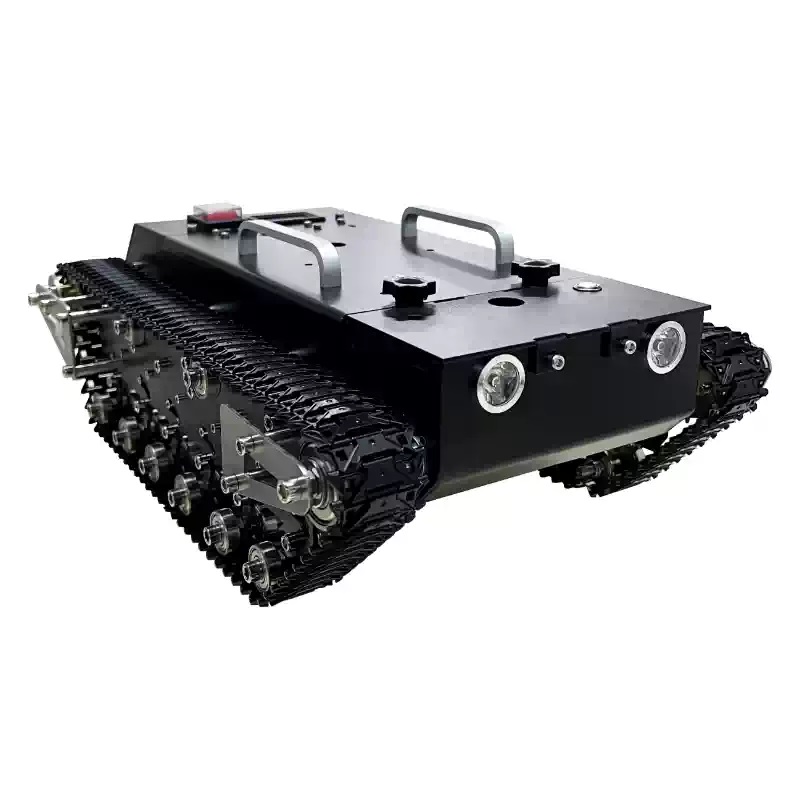
Robotics research teams, university engineering departments and small robot startups often face heavy time and capital pressure in prototype development. Self-developed tracked chassis require lengthy mechanical design, suspension testing and drive debugging; low-cost plastic crawler platforms break easily outdoors and cannot protect high-precision sensors from vibration damage. Many closed-source chassis lock core motion algorithms, forcing developers to spend months adapting underlying control logic. Weide HK WD-WT200S all-metal tracked off-road chassis solves multiple R&D pain points with full metal structure, independent suspension and open STM32 development architecture, lowering the entry threshold for outdoor unmanned vehicle algorithm development and competition prototype production.

1. All-metal anti-collision structure avoids frequent prototype replacement in complex field tests

Most entry-level robot chassis use plastic frames and rubber tracks, which crack or deform after hitting stones, tree roots or steps during outdoor field trials. Each damage requires a new prototype to be remanufactured, wasting lab procurement budgets and delaying project schedules. The WD-WT200S chassis adopts integrated high-strength steel frame with anti-corrosion baking paint, matched detachable zinc alloy tracks with far higher tensile and impact resistance than ordinary rubber tracks. Even in gravel, lawn and rugged dirt road testing environments, the frame and crawlers remain intact. Labs and robot teams no longer need to reserve extra funds for spare chassis replacement, significantly cutting long-term hardware iteration costs for repeated field verification experiments.

2. Six-group independent suspension protects precision sensors from vibration interference

SLAM navigation, visual recognition and environmental detection algorithms rely on stable sensor data; chassis jitter caused by uneven terrain leads to large data drift, making experimental data invalid and requiring repeated testing cycles. This crawler chassis configures six sets of bilateral independent shock absorption assemblies, which buffer vertical bump vibration in real time when crossing ridges and small obstacles. Cameras, LiDAR and various detection modules mounted on the platform maintain stable acquisition signals without picture blurring or positioning deviation. For academic research projects that demand high data accuracy, the suspension system greatly improves the success rate of single field test and shortens overall research progress cycles.

3. High-torque geared motor eliminates power stall during slope and heavy-load testing

Low-power miniature chassis often stall when carrying sensor modules and experimental equipment up slopes, failing to complete continuous long-distance cruise tests. The WD-WT200S equips dual 12V 40W high-torque DC geared motors with optimized 1:30 reduction ratio, outputting stable traction to support a 20kg full payload and 30-degree maximum climbing angle. The motor controls heat generation within a safe range under continuous operation, suitable for all-day outdoor patrol and field data collection tasks. Developers do not need to redesign power transmission systems for heavy-load test schemes, saving mechanical redesign and motor matching labor costs.

4. Open STM32 control architecture removes barriers to secondary algorithm development

Many commercial crawler chassis adopt closed proprietary control boards, with encrypted underlying drive codes that cannot be modified, limiting customized speed adjustment, multi-sensor linkage and autonomous navigation logic development. This off-road chassis reserves standard interfaces for optional STM32 open-source mainboards, with fully exposed motion control parameters and transparent drive logic. Engineering students and startup R&D staff can directly write motion control, obstacle avoidance and path planning programs without reverse engineering the bottom layer. It shortens prototype development cycles by more than half compared with fully closed chassis, and is perfectly matched for robot competition entries and university teaching algorithm experiments.

5. Balanced off-road parameters cover indoor teaching and outdoor field dual scenarios

Many chassis on the market are split into indoor lightweight models and heavy outdoor versions, forcing labs to purchase two sets of equipment for different teaching and testing scenarios and raising total procurement expenditure. The WD-WT200S integrates balanced all-terrain performance: 70mm obstacle crossing height adapts to outdoor small ridges and lawn undulations, while adjustable 0–1.0m/s low-speed stable movement fits indoor classroom demonstration and algorithm debugging. A single chassis can satisfy daily teaching experiments, outdoor patrol detection and maker competition production demands, realizing multi-scenario equipment sharing and optimizing lab asset utilization efficiency.

6. Modular detachable design simplifies maintenance and batch prototype iteration

Integrated non-detachable chassis require full disassembly for track or motor maintenance, taking up valuable lab research time. Every core component of this tracked platform adopts a modular quick-disassembly layout; worn zinc alloy tracks can be replaced individually without removing the entire frame, and motors and suspension units are independently accessible for inspection. Weide HK also supports batch OEM modification for educational equipment suppliers and robotics competition organizers, adjusting reserved mounting holes and interface layouts according to customer sensor matching demands, providing unified stable hardware platforms for mass student prototype production.

Related News
Leave me a message
E-mail
info@tjwdhk.cn
Mobile
Address
Room 3025, Building 1, Zone F, Guangxuan Road, Airport International Headquarters Base, Dongli District, Tianjin City, China
X
We use cookies to offer you a better browsing experience, analyze site traffic and personalize content. By using this site, you agree to our use of cookies.Privacy Policy
RejectAccept