Email Us
News & Insights

How Much Robot Dog Do You Actually Need? A Spec-by-Spec Guide to Payload, Torque and IP Rating

2026-10-17 0 Leave me a message

How Much Robot Dog Do You Actually Need? A Spec-by-Spec Guide to Payload, Torque and IP Rating

A purchasing engineer's reference for matching quadruped platforms to real site conditions — with the full Weide model line laid out side by side.

The short answer

Most industrial robot dog purchases fail for one of two reasons: the platform is too small for the payload, or the IP rating is too low for the site. Payload and ingress protection decide the outcome before any software feature matters.

Weide builds ten quadruped and wheel-legged platforms across three load classes. The dividing lines are simple:

8–12 kg payload — inspection, research and teaching. WD-X1, WD-L1, WD-C1, WD-L1W, WD-C1W.

30–100 kg payload — heavy handheld tooling, rescue loads, fire reconnaissance. WD-E1, WD-E1W, WD-M1.

170 kg payload — fixed industrial equipment such as fire monitors, PTZ assemblies and environmental sensor stacks. WD-S1, WD-S1W.

If your payload is above 30 kg, only the S-series applies. If your site is a classified hazardous area, only WD-EX1 applies. Everything else is a question of speed, range and terrain.


Question 1: How much payload does an industrial robot dog actually carry?

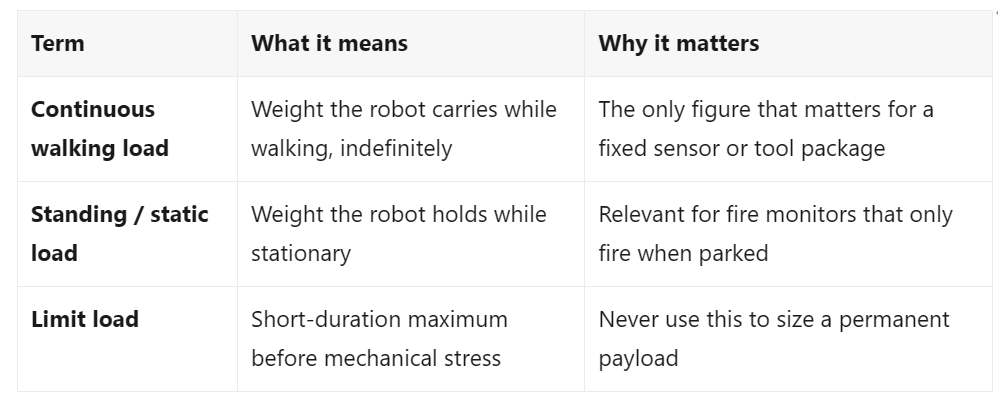
Payload numbers are quoted in three different ways across the industry, and they are not interchangeable.

Question 2: How much torque do the joints need?

Joint torque determines whether the robot can stand up again after a fall, climb a step, or hold a load at extension. Low-torque joints force a lighter payload to protect the gearbox.

Weide's joint modules fall into five torque tiers:

45–48 N·m — WD-X1 (45 N·m peak), WD-L1 (48 N·m). The light class: an 8 kg sensor package on gentle terrain.

71.4 N·m — WD-C1W. Higher torque than the C1 at a similar payload, because the extra four wheel drives add mass to move.

200 N·m — WD-E1, WD-E1W. The mid tier: a 52–60 kg body with a 30 kg walking load or 100 kg standing load.

500 N·m — WD-EX1. Explosion-proof joint design, built for Zone 2 hazardous areas.

600 N·m — WD-S1, WD-S1W. The top tier: bodies above 118 kg and 170 kg payloads.

Torque alone does not predict performance. A 600 N·m joint on a 128 kg body and a 600 N·m joint on a 118 kg body produce different acceleration profiles. Body mass matters as much as the torque figure.

Question 3: Which IP rating does my site require?

IP54 handles dust and light rain. It is an indoor and covered-area rating. WD-L1 and WD-L1W are laboratory and campus platforms; the manufacturer's own guidance says they must not be soaked in water or run in sustained heavy rain.

IP66 handles dust-tight sealing and powerful water jets. Adequate for outdoor yards, construction sites and washdown areas.

IP67 handles temporary immersion. WD-M1 carries this at the whole-machine level; WD-C1, WD-C1W and WD-S1 carry it at the joint level — and the joints are the parts most exposed to splash and standing water.

Temperature is the second half of the question, and it is easy to overlook. WD-C1, WD-C1W and WD-M1 publish a -20 °C to 55 °C range. WD-L1 publishes -10 °C to +45 °C. WD-L1 is therefore not a cold-store or high-temperature plant platform, even though its IP54 rating looks adequate for a clean indoor site.

About Tianjin Weide Aviation Technology Co., Ltd.

Tianjin Weide Aviation Technology Co., Ltd. designs and manufactures mobile robotic platforms and unmanned systems from its facility in Dongli District, Tianjin, China. The company was established in September 2024, holds ISO 9001 certification valid through December 2028, and is registered as a national technology-based SME. Its portfolio covers wheeled, tracked, quadruped and wheel-legged chassis, UAV systems and complete robot development, with OEM/ODM cooperation and custom chassis engineering available.

FAQ

Q: What is the difference between continuous walking load and standing load on a quadruped robot?

Continuous walking load is the weight the robot carries while moving indefinitely. Standing load is the weight it supports while stationary. For a fire monitor that only operates when parked, standing load applies. For a LiDAR head that runs during patrol, continuous walking load applies. On WD-S1 the two figures are 170 kg and 100 kg respectively.

Q: Is IP66 enough for outdoor industrial use?

IP66 is dust-tight and resists powerful water jets. It suits outdoor yards, construction sites and washdown areas, but does not cover immersion. For sites with standing water or heavy splash at joint level, look for IP67 on the joints — WD-C1, WD-C1W and WD-S1 all reach IP67 at the joint.

Q: Can a standard quadruped robot enter a Zone 2 hazardous area?

No. Zone 2 entry requires Ex certification — for the Weide line, Ex IIB T4 Gb on the WD-EX1. IP rating addresses ingress protection only and does not cover ignition risk.

Q: Which Weide model carries the highest payload?

WD-S1 supports 170 kg continuous walking load with a 118 kg body and 600 N·m joints. WD-S1W supports 170 kg standing load with a 128 kg body and a 6 m/s top speed.

Related News
Leave me a message
Email
info@tjwdhk.cn
Address
Room 3025, Building 1, Zone F, Guangxuan Road, Airport International Headquarters Base, Dongli District, Tianjin City, China
X
We use cookies to offer you a better browsing experience, analyze site traffic and personalize content. By using this site, you agree to our use of cookies. Privacy Policy
RejectAccept