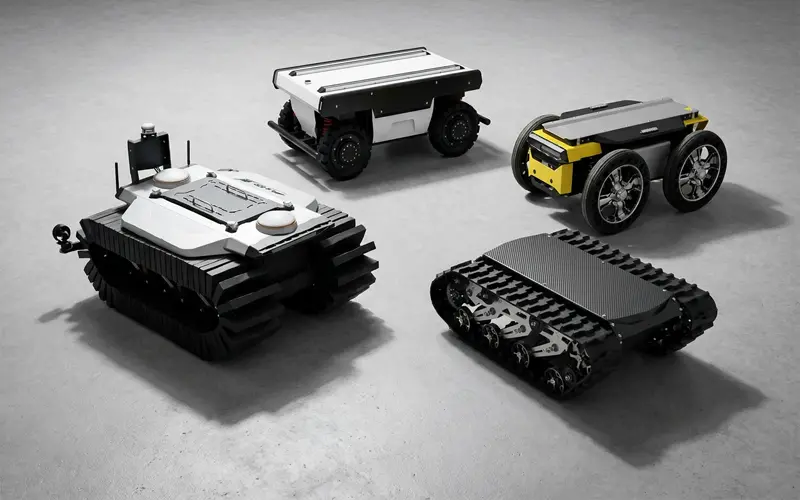
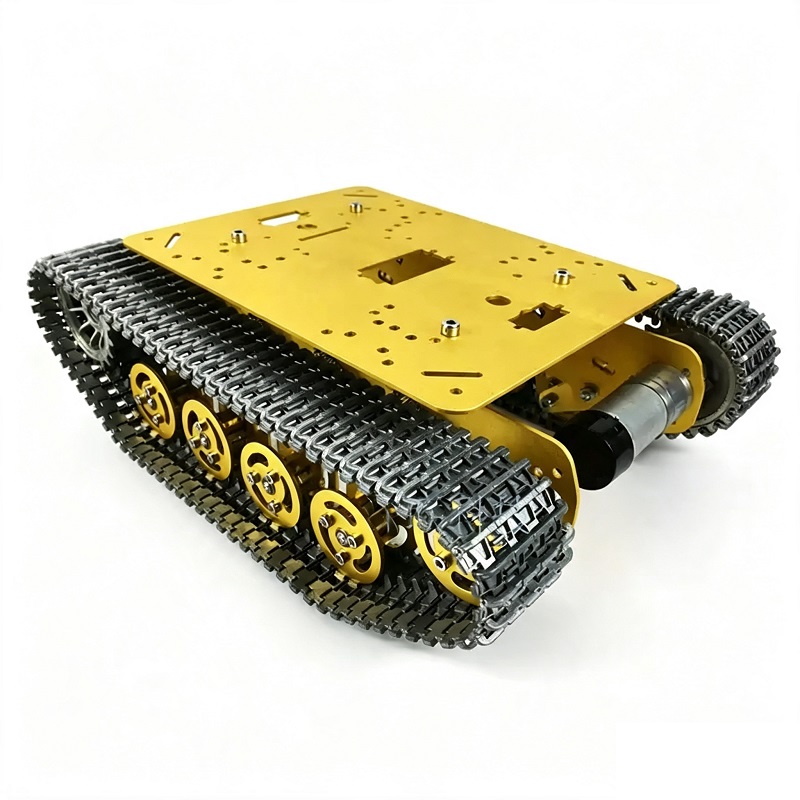
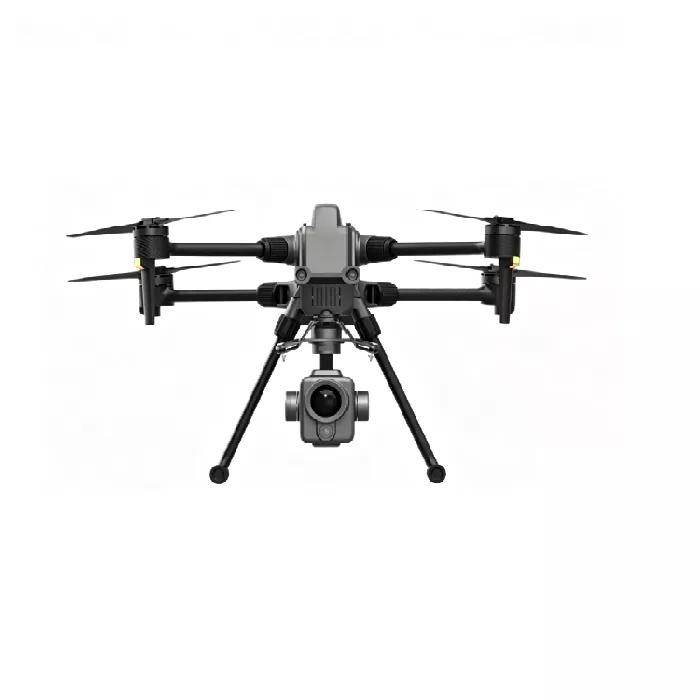
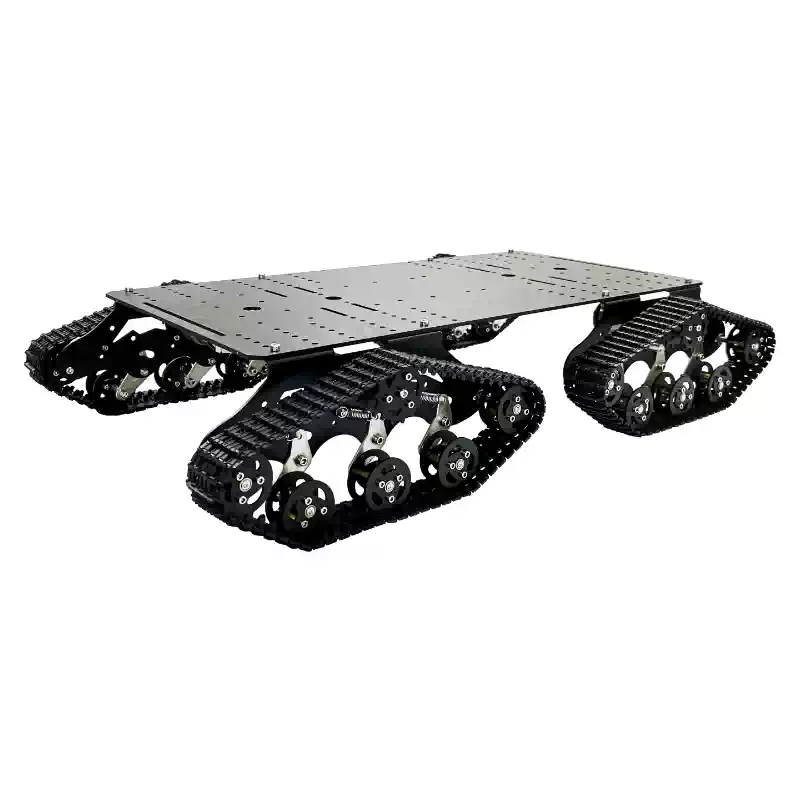
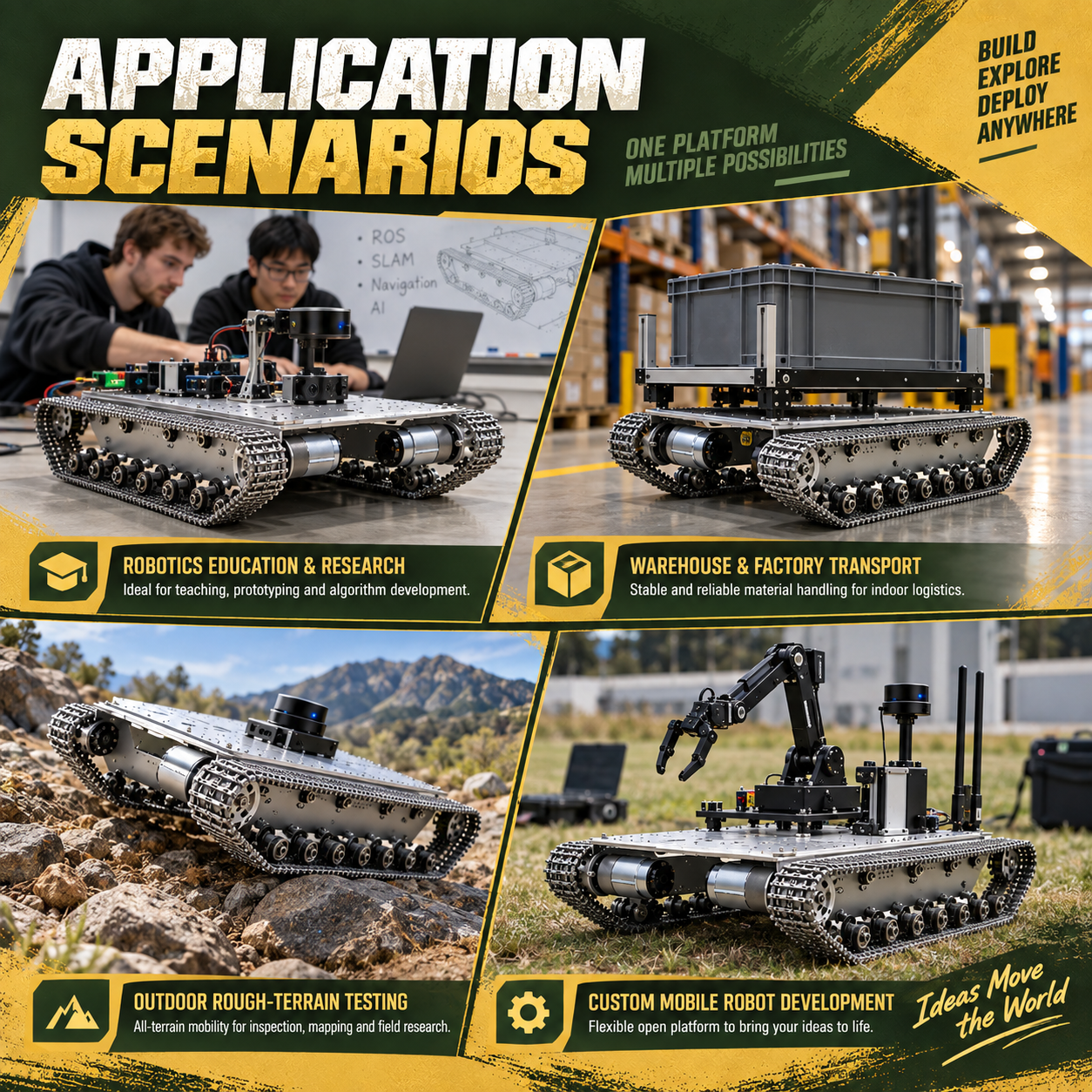
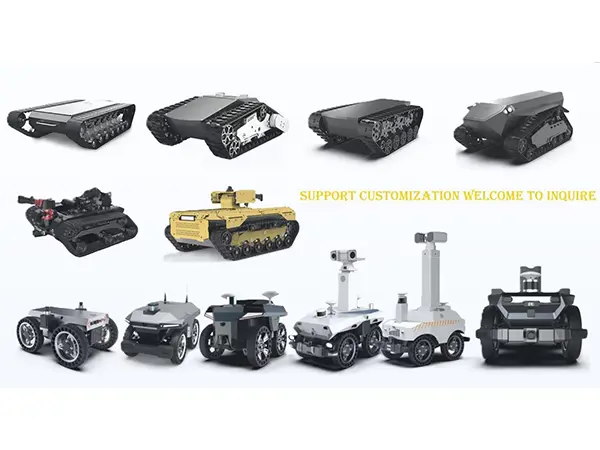
For the mobile robot industry, the chassis acts as the “legs” of a robot. It is the fundamental carrier that defines load capacity, terrain adaptability, endurance, and navigation stability. Whether you are building autonomous inspection robots, agricultural robots, warehouse AGVs, construction robots, robotic mowers, or research platforms for secondary development, your chassis selection will greatly affect on-site performance, failure rate and total operational cost. Many system integrators, solution providers and research teams face the same question at the early project stage: should they choose a tracked chassis or a wheeled chassis?
There is no universal winner between tracked and wheeled chassis. They are two mobility systems designed for distinct working conditions. No single chassis fits every scenario. The best choice always depends on your actual operation environment. In this article, we break down both solutions from ground mechanics, motion performance, navigation compatibility, maintenance cost, IP protection and secondary development, to help you make a reliable decision.
Tracked Robot Chassis
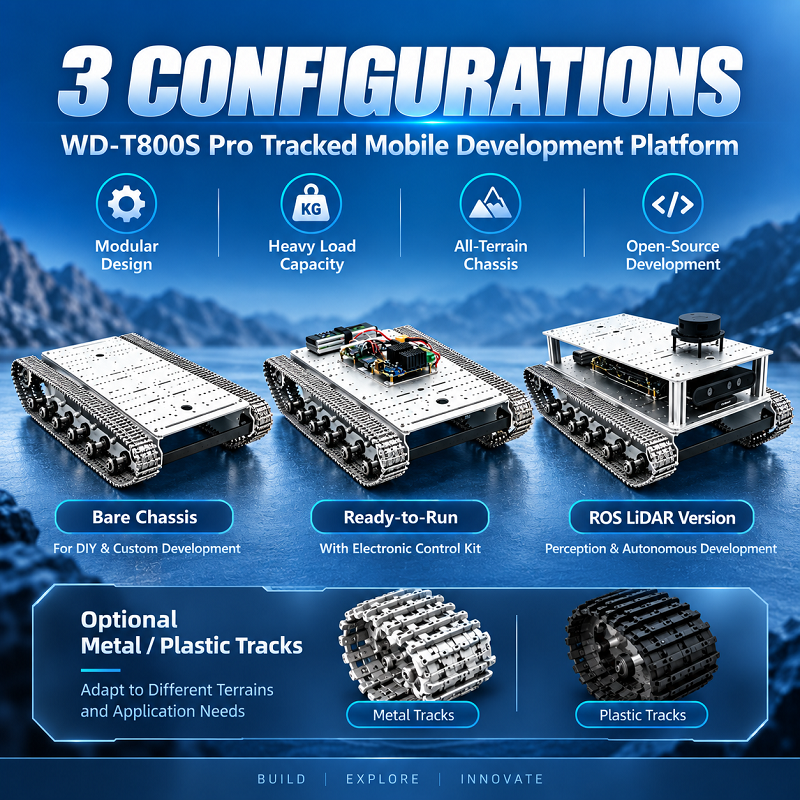
A tracked chassis uses continuous rubber or steel tracks to create a large contact area with the ground. This spreads the robot’s self-weight and payload evenly and reduces ground pressure significantly. This core advantage prevents sinking in mud, sand, snow, wetland and soft farmland. Tracks also create strong grip with the ground, delivering powerful traction, excellent climbing ability, obstacle crossing and ditch-crossing performance.
Most standard tracked chassis support in-place zero-radius rotation. They do not require extra turning space, so they can maneuver freely in narrow outdoor paths, busy construction sites, rubble zones and dense vegetation. This feature is extremely valuable for inspection, EOD and search & rescue missions.
✅ Key Advantages
Outstanding off-road performance for unstructured terrain: gravel, slopes, steps, trenches and muddy ground;
High traction and stable heavy-load operation, compatible with LiDAR, V-SLAM navigation modules, PTZ cameras, gas sensors and other end-effectors;
Zero-radius in-place rotation, flexible movement in confined outdoor spaces;
Low-center versions offer strong anti-tipping performance for long-duration stationary tasks on slopes.
❌ Limitations to consider
High friction between tracks and ground leads to lower speed and higher power consumption, resulting in shorter battery runtime compared with wheeled chassis under the same power setup;
Tracks, rollers, idlers and tension assemblies are consumable parts. They wear over time and require regular tension adjustment or replacement, increasing maintenance workload and cost;
Relatively high vibration during travel. If equipped with high-precision optical measurement devices, extra shock absorption structures are required;
Rubber tracks may leave marks and wear quickly when running long hours on smooth hard pavement, making them unsuitable for cleanrooms or premium indoor environments.
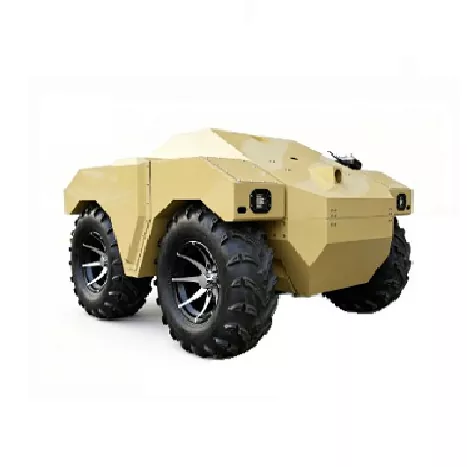
Wheeled chassis is the most mature and widely adopted mobility solution, with multiple sub-types including differential drive, 4WD Mecanum wheel, Ackermann steering and four-wheel independent steering. Each wheel configuration meets different motion requirements. Wheeled robots move by rolling, which creates far less resistance than sliding friction of tracks, bringing much higher energy efficiency.
Wheeled chassis run smoothly with low vibration and low noise. This is friendly to LiDAR and vision cameras, reducing SLAM mapping drift and positioning loss caused by heavy bumps. The whole mechanical system is highly standardized. Drive motors, reducers, wheel hubs and bearings are common off-the-shelf components, easy to source, replace and repair. Long-term maintenance expense stays controllable.
✅ Key Advantages
Low rolling resistance saves power and extends battery life for long continuous shifts;
Smooth low-vibration movement, ideal for V-SLAM, laser SLAM and visual navigation with stable mapping and positioning;
Simple mechanical layout, standardized spare parts, short lead time and easy troubleshooting;
Higher top speed for rapid patrol and frequent material transfer; motion control algorithms are mature with rich ROS ecosystem support.
❌ Limitations to consider
Small contact area creates high ground pressure, which easily causes slipping or sinking on soft mud and sand;
Obstacle height and climbing angle are generally lower than equivalent tracked chassis. Steps, pits and rough wild terrain are challenging;
Differential and Ackermann steering require turning radius, less agile in narrow aisles compared with in-place rotating tracked or Mecanum systems;
Mecanum wheels allow omnidirectional movement but the internal rollers wear fast, and they demand flat ground, not suitable for rough outdoor sites.
🎯 Ideal Application Scenarios
Factory AGV handling, warehouse automatic transport, indoor lab inspection, campus pavement patrol, cleanroom material delivery, office security robots, ROS research platforms for universities and prototype validation.
Comprehensive Selection Checklist (Beyond just ground surface)
Many buyers only look at ground conditions, but real projects require extra evaluation:
Navigation system: high-precision V-SLAM / laser SLAM mapping without heavy off-road tasks → wheeled for lower vibration; outdoor GPS-denied, changing terrain → tracked chassis;
Load & endurance: long continuous shifts and priority on power saving → wheeled; heavy payload, short-cycle off-road missions with priority on passability → tracked;
Maintenance support: limited on-site technicians, minimal servicing expectation → wheeled; dedicated maintenance team ready for regular consumable replacement → tracked;
IP rating: both tracked and wheeled chassis can be customized to IP66 for waterproof and dustproof. For rainy and dusty outdoor deployment, protection can be upgraded on request;
Secondary development: Our tracked and wheeled chassis come with reserved standard interfaces, support ROS & ROS2, and open low-level control protocol for integrators to develop custom navigation, scheduling and task systems.
Closing Notes
The chassis lays the foundation of your robot project. Replacing it after finalization will bring high rework cost. If your application covers both smooth indoor floors and rough outdoor terrain, a single chassis type can hardly satisfy all demands. In this case, separate platforms or hybrid mobility schemes can be evaluated.
We supply standardized tracked chassis and multiple wheeled chassis options (differential / Ackermann / 4WD). Customization on payload, IP rating, pre-installed navigation, shock absorption and peripheral interfaces is available. If you can share your payload, road condition, max climbing angle, runtime requirement, navigation scheme and working environment, we can prepare a tailored chassis proposal and specification sheet for you. Feel free to discuss your project with us.
We use cookies to offer you a better browsing experience, analyze site traffic and personalize content. By using this site, you agree to our use of cookies. Privacy Policy